Short answer: drywall finish levels are the industry’s 0-to-5 scale for how smooth a taped wall is before paint. For a home, three of them matter. Level 3 ($2.25–2.85 per square foot turnkey) is for garages and utility rooms. Level 4 ($3.00–4.25) is the standard for living spaces under flat or eggshell paint and is what about nine rooms in ten should get. Level 5 ($4.25–5.75) adds a skim coat over the whole surface and is for raking light, high ceilings and dark or glossy paint. All before HST. Below is what each level includes, where it belongs, how to tell what you have now, and the mistakes that make walls look bad after the painter leaves.
The six drywall finish levels at a glance
The levels are defined by the Gypsum Association’s recommended specification (GA-214), which every taper in Ontario works to whether they quote it or not. Each level builds on the one below.
| Level | What has been done | Where it is used | Turnkey cost per sq ft |
|---|---|---|---|
| 0 | Board hung, nothing taped | Temporary construction, or when the finish is decided later | Not sold separately |
| 1 | Tape set in joint compound, excess removed | Plenums, above ceilings, concealed areas that need smoke control | Not sold separately |
| 2 | Tape plus one coat over joints and fasteners | Behind tile, garages and storage where looks do not matter | Not sold separately |
| 3 | Tape plus two coats over joints and fasteners; surface left with slight texture | Garages, utility rooms, walls going under heavy texture or thick paint | $2.25–2.85 |
| 4 | Tape plus three coats over joints and fasteners, sanded smooth | Standard rooms under flat or eggshell paint or a light texture | $3.00–4.25 |
| 5 | Level 4 plus a skim coat over the entire surface | Gloss or semi-gloss paint, dark colours, raking light, high ceilings | $4.25–5.75 |
Prices are per square foot of board, turnkey, from our drywall installation page; minimum labour charges are $1,000 for Level 3, $1,500 for Level 4 and $2,800 for Level 5. Ceilings sit at the top of each band, and Toronto jobs do too because of access and parking.
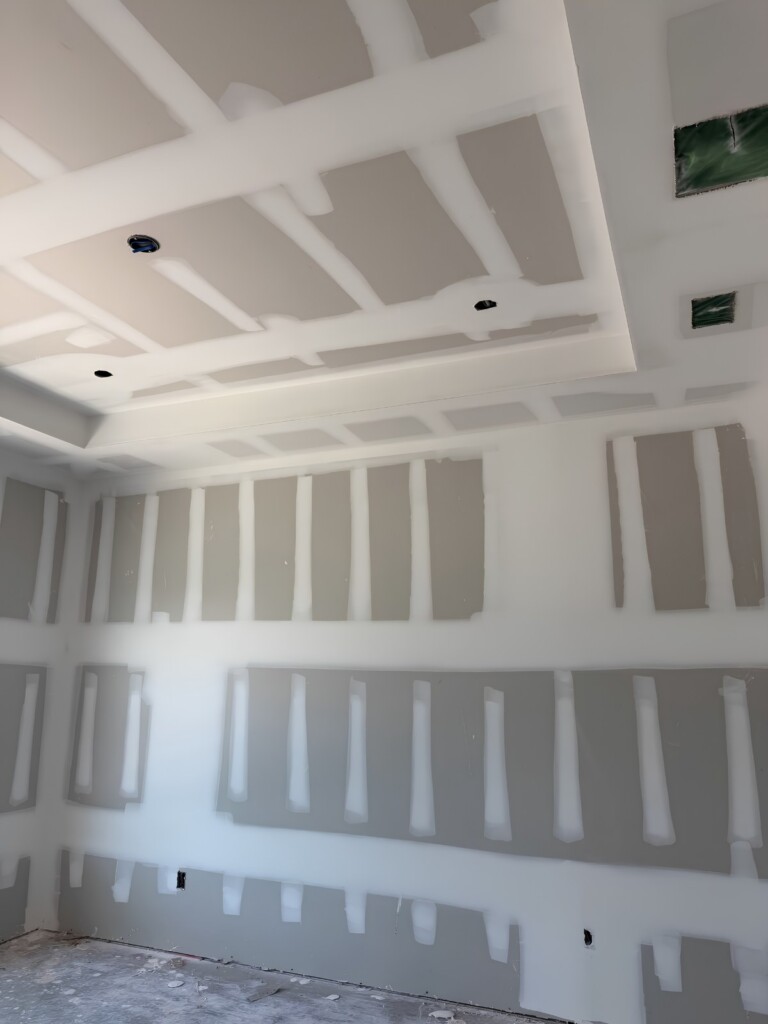
Level 3: where it is enough
Level 3 gets the joints and screws covered and reasonably flat, but the surface is not sanded smooth and tool marks remain. Under a heavy sprayed texture or a thick coat of garage paint, none of that shows, which is why it is the right spec for a one- or two-car garage, a furnace room, a workshop or a storage area. It is the wrong spec for any room you will live in: under ordinary wall paint the seams read as faint bands and every screw shows as a dimple, and no primer fixes that. If a quote for a bedroom comes in far below the others, check whether it is quietly a Level 3.
Level 4: the standard
Level 4 is three coats over every joint and every fastener, each one wider than the last, then sanded so the seams feather invisibly into the board. It is what most people mean by “finished drywall” and it is the most-chosen tier for a reason: under flat, matte or eggshell paint in normal daylight it looks perfect, and it costs a fraction of a Level 5. Bedrooms, hallways, family rooms, offices, finished basements with normal ceiling heights — Level 4 throughout. The full cost picture, including what a room and a basement come to, is in our guide to drywall installation cost in Ontario.
Its one limitation is physics. Level 4 leaves two surfaces on the wall — the paper face of the board and the compound over the seams — and they absorb paint slightly differently. Under flat and eggshell sheens, and with light coming at the wall rather than across it, the difference is invisible. Change either of those conditions and it is not.
Level 5: when it is genuinely needed
Level 5 covers the whole wall or ceiling with a thin skim coat of compound so there is one uniform surface. The labour is roughly double Level 4 because every square foot gets coated and sanded, not just the seams. It earns its price in four situations:
- Raking light — a long wall with a big window at one end, a hallway with a window at the far end, or any wall lit by a strip of pot lights along its top. Light travelling along the surface throws a shadow off every seam that a Level 4 finish leaves.
- Ceilings under pot lights — the same effect, overhead, where every joint runs across the light. Living-room ceilings are the most common Level 5 we do.
- Dark, glossy or semi-gloss paint — sheen amplifies texture differences, and dark colours make the paper-versus-compound absorption difference visible as flashing. See how sheen is chosen on our interior painting page; if you want a deep colour or a satin finish on a wall, spec Level 5 first.
- Tall walls and stairwells — big uninterrupted surfaces where the eye has nothing to break up a flaw.
Where it is wasted: a bedroom with eggshell paint and a window on the adjacent wall, a walk-in closet, a garage. In those rooms Level 4 and Level 5 look identical and the difference is money.
How to tell what level you have now
Take a bright flashlight after dark, hold it flat against the wall and shine it along the surface, parallel to the wall. This is raking light on demand. If every seam and screw shows up as a ridge or dimple, you have Level 3 or a poor Level 4. If the seams are invisible but you can just make out the difference between compound and paper as a faint change in sheen, that is a good Level 4. If nothing shows at all, it is Level 5 or has been skim-coated. On an older wall with many patches, the flashlight will also show you every repair, which is why a wall with a lot of history is often better skimmed than patched again — see our drywall repair guide for when that makes sense.
The mistakes that make good drywall look bad
- Level 4 under gloss. The wall was fine until someone chose semi-gloss for a feature wall. Every seam flashes. The fix is a skim coat and a repaint — so decide the sheen before the taper leaves.
- Level 5 in the garage. A real cost with no visible benefit. Level 3 and a thick coat of paint.
- “Primer will fix it.” Primer evens out absorption; it does not fill a ridge or a dimple. What is there at Level 3 is still there after two coats of anything.
- One level for the whole house. Rooms have different light and different paint. Spec them one at a time.
- Skipping the sanding. Three coats unsanded is not Level 4. A quote should say “sanded” or “ready for paint”.
How to write it into a quote
List rooms and assign a level to each: Level 4 for the living spaces, Level 3 for the garage and utility room, Level 5 for the living-room ceiling and any wall with a big window at one end. Ceilings can carry a different level from the walls in the same room. Note which rooms will get dark or glossy paint. A written drywall quote should show the level and the board area for each room, the minimum charge if it applies, and HST as a separate line — the same structure we use for drywall installation in Toronto, Mississauga and Hamilton, where older plaster walls often make a skim coat the practical way to reach Level 5.
IntraBuild quotes drywall by level, per room, for the GTA and Southern Ontario: one insured crew, a written price, no travel fee. Get a drywall installation quote or call (647) 558-8723.
Frequently asked questions
What is a Level 5 drywall finish?
A Level 4 finish — tape and three coats over joints and fasteners, sanded — plus a thin skim coat of joint compound over the entire surface, sanded again. It produces one uniform surface so paint reads the same everywhere. It costs $4.25–5.75 per square foot turnkey, before HST.
Is Level 5 worth the cost?
Yes where light rakes across the surface, under pot lights, under dark or glossy paint, and on tall walls. No in a normal bedroom with eggshell paint — there it looks identical to Level 4 at roughly double the labour.
What finish level does a garage need?
Level 3, at $2.25–2.85 per square foot. If the garage is being finished as living space or a gym with normal wall paint, treat it as a room and spec Level 4.
Does paint hide Level 4 seams?
Flat and eggshell paint in normal light, yes — that is the whole point of Level 4. Satin, semi-gloss, gloss or dark colours, no; they make the seams and the paper-versus-compound difference visible, which is what Level 5 is for.
What level do new builds get?
Almost always Level 4 in living areas and Level 3 in the garage, often with a light ceiling texture to save a step. If a builder’s home has a ceiling that looks wavy under pot lights, that is a Level 4 ceiling in a Level 5 situation, and a skim coat is the remedy.